10 Tips to Check Before Buying a Used Electric Forklift

Time:2026-11-13 Author:Mason
0%

Buying a used electric forklift can look simple from the sales photo. The real story sits in the battery compartment, mast, tires, and service records. Before you commit, ask: “What should I check before buying a used electric forklift?” A careful inspection can reveal costly wear that a clean paint job hides.

For this guide, fictional forklift service adviser Alex Morgan offers a practical reminder: “A quiet test drive is useful, but the battery and maintenance history tell you more.” This is an illustrative quote, not a statement from a verified industry source. Use it as a prompt to ask better questions. Request battery test results, check for corrosion around terminals, and look for cracked insulation or loose connectors. Raise and lower the mast; listen for grinding and watch for uneven movement. Small details matter.

Then inspect the forks, chains, tires, brakes, and steering. Ask when the forklift last received professional service, and compare its hour meter with available records. Take a controlled test drive with a qualified operator. Notice whether the truck pulls to one side, hesitates, or displays warning lights. No single check proves a forklift is sound. A technician may still find faults you missed. That is worth remembering. A pre-purchase inspection adds time, but it can prevent a rushed decision—and an expensive surprise after delivery.
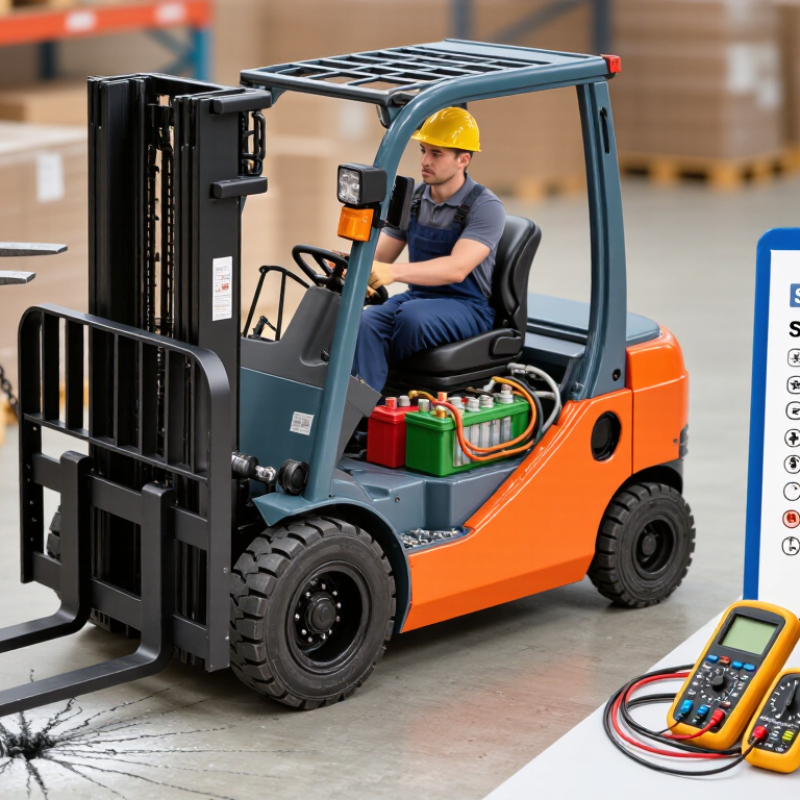
10 Tips to Check Before Buying a Used Electric Forklift

Define Your Lifting and Operating Requirements

Before inspecting a used electric forklift, write down the heaviest load, its dimensions, and the highest lift point. Weight alone is not enough. A long pallet shifts the load center forward, reducing the truck’s safe capacity. OSHA’s powered industrial truck guidance advises checking the capacity plate and staying within the truck’s rated limits. Confirm the plate matches the installed mast and attachments. A rating for one configuration may not apply to another.

Measure the narrowest aisle, doorway, ramp, and turning area at your actual site. Note floor joints and slopes, too; a truck that feels stable on a smooth showroom floor may behave differently on rough concrete. ANSI/ITSDF B56.1 treats load center and stability as core operating considerations, so compare your real loads with the truck’s specifications—not just its headline capacity. For example, record whether pallets carry centered cartons or long, uneven materials. Small details matter.

Also map the work cycle: hours per shift, travel distance, lift frequency, and time available for charging. OSHA identifies battery charging as a designated task area, so make sure your site can support safe charging and routine access. Ask for battery service records and check whether the battery can cover your expected shift. It may not. A tidy truck can still be the wrong fit. Recheck your assumptions against a normal, busy day, not an ideal one.

Review the Forklift’s Age, Service Records, and Ownership History

Check the forklift’s data plate and note its manufacture year, rated capacity, and battery type. Age matters, but it is not a verdict. A carefully maintained older truck may be a safer purchase than a newer unit with neglected service. Compare the hour meter with maintenance dates and visible wear on the pedals, forks, and seat. A low reading is useful only if the records support it.

Ask for dated service records, not just a verbal account. Look for battery tests, charger checks, hydraulic repairs, tire changes, and replacement of worn parts. Repeated repairs to the same system may point to an unresolved problem. Look closely. Missing records do not prove poor care, but they leave you guessing. Ask who performed the work and whether receipts or inspection notes are available.

Trace the forklift’s ownership history. Confirm that the seller’s paperwork identifies the same machine shown on the data plate, and ask how it was used at each site. A truck used indoors on smooth floors can have different wear from one used outdoors on rough ground. If the timeline has gaps, request an explanation and verify details before paying. I would not rely on a polished folder alone; some records are incomplete, and that should affect how confidently you assess the asking price.

10 Tips to Check Before Buying a Used Electric Forklift - Review the Forklift’s Age, Service Records, and Ownership History

Tip What to Check Useful Evidence Warning Signs
1. Verify the build date Read the identification plate and compare its manufacture date with the seller’s description. A legible plate showing the model, serial number, year, and rated capacity. A missing, altered, or inconsistent plate; age alone does not establish condition.
2. Compare operating hours Check the hour meter and ask how the hours were recorded and whether the meter was replaced. Service invoices or inspection logs with dated hour readings. Readings that go backward or differ substantially from documented records without explanation.
3. Review service records Look for routine inspections, repairs, and follow-up work, with dates and equipment identifiers. Dated work orders, invoices, or maintenance logs that match the forklift’s serial number. Long undocumented periods, repeated unresolved faults, or records for a different unit.
4. Establish ownership history Ask how many owners or operating sites the forklift has had and why it is being sold. A consistent ownership timeline and available purchase, lease, or transfer documents. Unclear ownership, unexplained gaps, or refusal to confirm the seller’s authority to sell.
5. Inspect the battery Confirm battery type and rated voltage; inspect the case, connectors, cables, and charging behavior. Battery identification details, maintenance history, and a qualified battery condition test. Cracks, leaks, overheating, damaged cables, or weak performance under normal operation.
6. Check the charger Confirm that the charger is compatible with the battery’s voltage and chemistry, and inspect its cables and plug. Charger specifications and a supervised charging test, where available. Incompatible ratings, damaged insulation, loose connections, or charging faults.
7. Examine the mast and forks Inspect chains, rollers, hoses, fork heels, locking pins, and visible mast movement. A hands-on inspection and, if needed, measurements by a qualified technician. Cracks, bent forks, excessive wear, damaged chains, or hydraulic leaks.
8. Test safety systems Test the brakes, steering, horn, lights, warning devices, seat restraint, and operator-presence features fitted to the unit. A controlled functional test and current inspection documentation, if applicable. Any nonworking safety feature, inconsistent braking, or warning indicator that remains illuminated.
9. Confirm capacity and attachments Match the data plate’s rated capacity and load center to your intended loads; verify approved attachments and any capacity changes. A readable capacity plate and attachment documentation suitable for the configuration. Missing capacity information, unverified modifications, or a rating unsuitable for the intended work.
10. Arrange an independent inspection Have a qualified technician assess the forklift under safe operating conditions before purchase. A written condition report identifying defects, repair needs, and items requiring further testing. Pressure to skip inspection or restrictions that prevent basic checks and a safe test.

Inspection findings should be assessed against the forklift’s identification plate, applicable safety requirements, and intended operating conditions.

Inspect the Battery, Charger, and Electrical Systems

Begin with the battery case, not just the charge display. Look for cracks, swelling, damp patches, or white and green corrosion around terminals. These marks can point to leaks, overheating, or neglected maintenance. Small clues matter. If the battery is a serviceable flooded type, have a trained technician check electrolyte levels; sealed batteries should not be opened. Ask to see recent service records and note whether the battery reaches a stable charge. A full meter reading alone does not prove it can run a full shift.

Check that the charger’s output matches the battery’s voltage and charging requirements. Inspect its cable insulation, plug, and strain relief for cuts, looseness, or scorch marks. Connect it during the inspection if possible. Listen for unusual buzzing and watch for warning lights or error codes. Warmth may be normal, but a hot plug or burning smell is not. Then test the forklift’s lights, horn, display, lift, and travel functions. Watch for flickering, sudden power loss, or sluggish lifting. A clean exterior can mislead. One short test cannot reveal every fault, so have a qualified technician assess anything uncertain before purchase.

Examine the Mast, Forks, Tires, Brakes, and Safety Features

Start with the mast lowered and the forklift parked on level ground. Look for bent rails, cracked welds, leaking hydraulic hoses, and rust around the lift cylinders. Check that the chains sit evenly and show no damaged links. Raise and lower the mast slowly in a clear area. Watch for jerking, unusual noise, or uneven movement. Small flaws matter.

Inspect both forks from heel to tip. Their tips should be level, with no cracks, deep gouges, or obvious bending. Compare the fork heights; even a small difference can affect load stability. Check tires for missing chunks, flat spots, and uneven wear. Solid tires can hide damage on their inner surfaces, so look closely. I might miss that.

Test the service and parking brakes at low speed in an open space. The truck should stop smoothly and hold when parked. Confirm the horn, lights, backup alarm, seat belt, and any fitted safety interlocks work. Check that labels are readable and the operator’s view is not blocked by attachments. A tidy exterior is not proof of sound condition. A short inspection cannot reveal every internal fault, so have a qualified technician assess concerns before purchase.

Test Drive the Forklift and Compare Its Total Cost of Ownership

Take the forklift through the same route and workload it will face on your site. Lift a realistic pallet, turn in a tight aisle, brake, reverse, and listen for uneven motor noise. Watch for mast drift, jerky lifting, warning lights, or a battery gauge that drops sharply under load. A clean-looking battery can still disappoint. Ask for its age, service records, and charging history, then have a technician test it under load. A smooth five-minute drive is evidence, not proof.

Compare total cost of ownership over your expected holding period, not just the asking price. Include charging electricity, battery repairs or replacement, tires, scheduled maintenance, and downtime. The U.S. Energy Information Administration’s Electric Power Monthly reported an average commercial electricity price of about 12.6 cents per kilowatt-hour in 2023. That is a benchmark, not your bill; local rates and demand charges can differ.

Record the electricity used for a full charge, then apply your site’s actual tariff. Compare that figure with the used truck’s battery condition and your expected operating hours. If the seller cannot provide clear maintenance records, price the uncertainty into your offer.

It is easy to underestimate downtime. Don’t.

FAQS

What should I write down before inspecting a used electric forklift?

Record your heaviest load, its dimensions, and the highest lift point. Include long or uneven pallets. Small details matter.

Why does load length affect forklift capacity?

A long pallet moves the load center forward and can reduce safe capacity. Check the capacity plate for the installed mast and attachments.

What should I measure at my worksite?

Measure the narrowest aisle, doorway, ramp, and turning area. Note floor joints and slopes. Showroom floors can hide problems.

How can I check whether the battery suits a shift?

Ask for its age, service records, and charging history. Compare its tested performance with your operating hours and charging time. It may fall short.

What should I test during a drive?

Follow your usual route with a realistic pallet. Turn in a tight aisle, brake, reverse, and listen for uneven motor noise.

Which warning signs should I watch for?

Look for mast drift, jerky lifting, warning lights, or a battery gauge that drops sharply under load. A smooth short drive proves little.

What costs belong in a total ownership estimate?

Include electricity, battery repairs or replacement, tires, maintenance, and downtime. I might be too cautious, but unclear service records deserve a cost allowance.

How can I estimate charging electricity costs?

The 2023 U.S. commercial average was about 12.6 cents per kilowatt-hour. Your local rate may differ. Measure a full charge and use your actual tariff.

Conclusion

What should I check before buying a used electric forklift? Start by matching its lifting capacity, lift height, and maneuverability to the loads and conditions in your workplace. Review the forklift’s age, service records, and ownership history to understand how it has been maintained and used. Look for consistent maintenance documentation and note any gaps that may warrant closer inspection.

Carefully assess the battery, charger, wiring, and other electrical components, since their condition can affect reliability and operating costs. Inspect the mast, forks, tires, brakes, and safety features for wear, damage, or signs of poor maintenance. If possible, test-drive the forklift to evaluate its handling, lifting performance, and controls. Finally, compare the purchase price with likely maintenance, battery, charging, and operating expenses to estimate the total cost of ownership and decide whether the forklift is a practical fit.

Mason

Mason

Mason is a seasoned marketing professional with a deep expertise in the company's offerings and a passion for driving brand awareness. With a strong background in digital marketing strategies, he has an innate ability to connect with diverse audiences and effectively communicate product benefits.......