LM Forklift
Forklift aisle width is not a guess made from the space between two racks. It is the clear operating room a truck needs to enter, turn, retrieve a pallet, and leave without striking shelving or people. A few inches matter. A load that projects beyond the forks can change the maneuver, even when the truck itself fits.
How to calculate forklift aisle width requirements depends on the truck’s right-angle stacking dimension, load size, and operating clearance. Start with the manufacturer’s specification for the exact truck and attachment; then check the pallet’s dimensions and the way loads are stored. OSHA’s 29 CFR 1910.176(a) requires sufficient safe clearance in aisles and passageways, but it does not prescribe one universal aisle width. That distinction matters: a narrow-aisle reach truck and a counterbalance forklift do not turn alike.
The Material Handling Institute’s industry research documents the sector’s continuing investment in warehouse technology and operations, but equipment choices still need site-specific checks. Measure the aisle between the nearest load faces, not just between rack uprights. Confirm the result with the truck supplier and a real maneuver test using the intended pallet. As warehouse safety specialist guidance often stresses: “Use the truck’s published turning data, then verify it in the actual aisle.” Treat that as a check, not a guarantee; rack protection, floor conditions, and operator visibility can still change what feels safe.
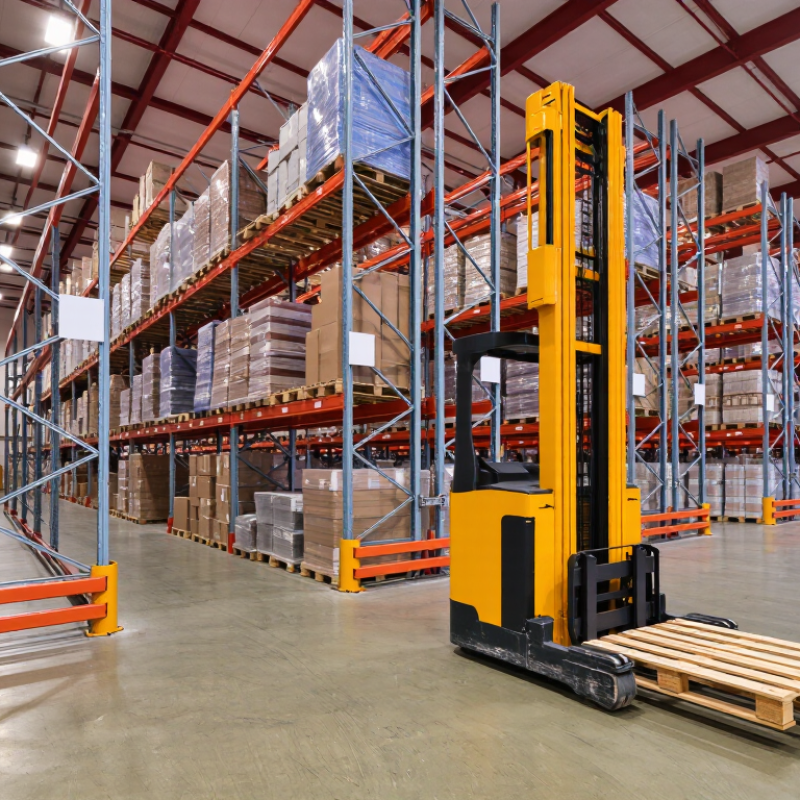
Forklift aisle width is the clear, usable space needed for a forklift, its load, and nearby workers to move safely.
Under OSHA 1910.176(a), workplaces must provide sufficient safe clearance for aisles, loading docks, doorways, and areas where mechanical handling equipment operates. OSHA does not give one universal aisle dimension. The correct width depends on the forklift, load size, turning method, and site layout.
To calculate it, measure the widest load, not only the forklift body. Add the equipment’s required turning clearance from the manufacturer’s specifications. Then include space for load swing, rack projections, structural columns, doors, and pedestrian separation.
For example, a loaded forklift may fit through a straight aisle but fail during a ninety-degree turn. Mark the proposed width on the floor and test it with the heaviest normal load.
Measure carefully.
A practical review should include travel speed, visibility, floor condition, dock edges, and emergency access. Keep the aisle free from pallets, shrink wrap, and temporary storage.
A simple formula can mislead when operators must reverse or handle unstable loads. I have found that real turning trials often expose problems missed on drawings.
Recheck the aisle after changing rack locations, load dimensions, or forklift types. The final clearance should support controlled movement, not merely allow the machine to pass.
Need improvement.
Forklift aisle width starts with the truck’s Ast, or right-angle stacking aisle width. Check the specification sheet for the exact truck configuration and load dimensions it assumes. Ast commonly reflects a standard load and required operating clearance, so adding the full load length again can overstate the result. Verify before calculating. OSHA’s Powered Industrial Trucks eTool stresses using truck capacity information and considering the load and operating conditions; those details matter when comparing a published Ast with your actual pallets.
Record the truck’s overall length, width, and turning radius, then measure the load from fork heel to its farthest edge. A longer load may extend beyond the truck and change the space needed to turn or position it. Turning radius is useful for checking maneuvering space, but it is not a substitute for Ast. Measure the tightest aisle, including rack corners, columns, and protruding goods. Leave practical clearance for steering corrections. Real aisles are rarely perfect.
For a preliminary check, compare the truck’s stated Ast with the measured aisle, using the same load orientation and stacking method. OSHA’s guidance supports evaluating actual workplace conditions, not relying on a nominal truck dimension alone. Test the route with the intended load, especially at intersections and rack ends. A spreadsheet can help, but one overlooked pallet overhang can undo the calculation.
Forklift aisle width is the clear space needed for safe travel, turning, and load placement. It is not simply the distance between rack faces. Measure the forklift’s turning envelope, load width, rack depth, and required operating clearance. Add space for uneven pallets and small steering corrections.
A standard aisle commonly measures 12–13 feet. This range suits many counterbalance forklifts and allows comfortable turning around full pallets. It also gives operators better visibility when loads rise above eye level. A narrow aisle usually measures 8–10 feet. It can increase storage density, but it requires suitable equipment and more precise driving.
A practical calculation starts with the manufacturer’s minimum aisle specification. Then add clearance for the widest load and real workplace conditions. For example, a 42-inch pallet may need more room when it overhangs the forks. Floor damage, mixed pallet sizes, and busy intersections can change the answer.
Do not rely on a tape measure alone.
Walk the proposed route with a trained operator. Mark rack corners and test the tightest turn using an unloaded and loaded forklift. In my experience, plans often look efficient on paper but feel restrictive during placement. A few extra inches may reduce contact risks and improve daily productivity. However, excessive width can waste valuable storage space. Recheck the layout after seasonal inventory changes.
Forklift aisle width is the clear space needed for a loaded forklift to travel, turn, and place pallets safely. The practical calculation is simple: Aisle Width = Ast + Load Overhang + Safety Clearance. Ast is the truck’s required aisle dimension for the selected stacking operation. Always use the measurement for the actual forklift, load, and stacking method.
Measure the load while it is fully positioned on the forks. Record how far it extends beyond the fork tips or pallet edge. Add this overhang to Ast, then include safety clearance for steering variation, rack movement, and uneven floors. For example, an Ast of 2,900 mm, 100 mm of load overhang, and 200 mm of clearance requires a 3,200 mm aisle. I have seen layouts fail because designers measured an empty truck. That mistake is easy to make.
Tips: Confirm the figure with the forklift’s technical data and a loaded-floor trial. Mark the proposed aisle with tape, then drive slowly through it with the largest regular load. Watch the rear swing, pallet corners, and rack posts. Keep extra room where visibility is limited or loads are unstable. A formula gives a starting point, not a guarantee. Conditions change during daily work, and the narrowest practical aisle may need revision after observation.
| Forklift Application | Forklift Type | Ast Value (mm) |
Load Overhang (mm) |
Safety Clearance (mm) |
Calculation | Calculated Aisle Width (mm) |
Recommended Design Width (mm) |
|---|---|---|---|---|---|---|---|
| Standard pallet storage | Counterbalance forklift | 3,600 | 100 | 300 | 3,600 + 100 + 300 | 4,000 | 4,000–4,100 |
| Narrower pallet operation | Electric counterbalance forklift | 3,300 | 100 | 300 | 3,300 + 100 + 300 | 3,700 | 3,700–3,800 |
| Selective rack storage | Reach truck | 2,700 | 100 | 250 | 2,700 + 100 + 250 | 3,050 | 3,100–3,200 |
| High-density rack storage | Reach truck with extended load | 2,800 | 150 | 300 | 2,800 + 150 + 300 | 3,250 | 3,300–3,400 |
| Very narrow aisle storage | Articulated forklift | 2,100 | 100 | 200 | 2,100 + 100 + 200 | 2,400 | 2,400–2,500 |
| Long-load handling | Side-loading forklift | 3,800 | 250 | 350 | 3,800 + 250 + 350 | 4,400 | 4,400–4,500 |
| Outdoor yard operation | Rough-terrain forklift | 4,000 | 200 | 500 | 4,000 + 200 + 500 | 4,700 | 4,700–4,800 |
| Formula: Required Forklift Aisle Width = Ast + Total Load Overhang + Safety Clearance. Ast is the manufacturer-specified aisle dimension for the selected forklift, load size, and stacking method. The recommended design width is rounded upward to provide practical operating tolerance. | |||||||
| Planning note: These values are representative examples, not universal minimums. Confirm the final aisle width using the actual forklift specification, pallet dimensions, rack layout, turning path, floor conditions, pedestrian controls, and applicable local safety requirements. | |||||||
Forklift aisle width is not a universal number. It depends on the truck, load, rack depth, and turning method. Measure the largest load, including pallet overhang. Add the truck’s published turning radius, load length, and operating clearance. A practical check is: aisle width ≥ turning envelope + two safety clearances. The equipment manual and a full-scale floor trial should confirm the result. Drawings alone can mislead.
Fire protection must be checked beside the rack plan. NFPA 13 commonly requires at least 18 inches between stored materials and sprinkler deflectors, although storage height, commodity class, and sprinkler design can change that distance. The 2024 NFPA Fire Protection Handbook also stresses maintaining unobstructed sprinkler discharge. Rack beams, pallet loads, and temporary stock can quietly reduce this gap. It happens often.
Pedestrian safety needs a separate review. OSHA’s Powered Industrial Trucks standard, 29 CFR 1910.178, requires sufficient clearance in aisles and passageways, but it does not provide one universal aisle dimension. Use marked walkways, physical separation where practical, warning signs, and controlled crossing points. OSHA reports roughly 35,000 serious forklift injuries annually in the United States. That figure makes a narrow aisle more than a productivity issue. Verify emergency exits, fire lanes, rack protection, and local fire-code requirements with the authority having jurisdiction. A layout may pass the drawing review and still feel unsafe during a blind turn. Recheck it with the heaviest load.
It means the clear space needed for a loaded forklift, nearby workers, and safe movement. Measure usable space. Do not count blocked corners, columns, pallets, or stored materials.
No. The required width depends on the forklift, load size, turning method, and storage layout. A straight path may work. A ninety-degree turn may not.
Use this practical formula: Aisle Width = Ast + Load Overhang + Safety Clearance. Ast is the truck’s required aisle dimension for the selected stacking method. Confirm it using technical data and a loaded-floor trial.
Measure the fully positioned load on the forks. Record how far it extends beyond the fork tips or pallet edge. Do not measure only the empty forklift body.
Yes. Add the load overhang and suitable safety clearance. For example, 2,900 millimeters plus 100 millimeters plus 200 millimeters equals 3,200 millimeters. The formula is only a starting point.
Include room for steering variation, rack movement, uneven floors, load swing, and structural columns. Add more space near doors or poor-visibility areas. Small margins can disappear quickly.
Mark the aisle edges with floor tape. Drive slowly through it using the heaviest normal load. Watch the rear swing, pallet corners, rack posts, and turning path.
Measuring an empty forklift is a common mistake. Ignoring load instability is another. Temporary storage, shrink wrap, and pallets can also reduce usable clearance.
Recheck it after changing racks, load dimensions, forklift types, or stacking methods. Review dock edges, visibility, floor condition, speed, and emergency access. A layout can look correct on paper. It may still fail in daily work.
No. The aisle should support controlled movement, not merely allow passage. Tight designs may save space but increase steering errors. I may overlook unusual loads, so real observation remains necessary.
Forklift aisle width is the clear operating space needed for a truck to travel, turn, load, and unload safely without striking racks, walls, products, or people. Under OSHA 1910.176(a), aisles must provide sufficient clearance for the safe movement of materials-handling equipment and personnel. To determine how to calculate forklift aisle width requirements, begin by collecting the truck’s Ast, or aisle specification, turning radius, overall dimensions, and load length. Also measure any load overhang beyond the forks or pallet.
As a general planning reference, standard forklifts often require aisles of about 12–13 feet, while narrow-aisle equipment may operate in approximately 8–10 feet when the truck and layout are designed for that space. A practical calculation combines the truck’s Ast with the load overhang and an appropriate safety clearance. The final measurement should then be checked against rack dimensions, turning paths, fire-code provisions, emergency access, visibility, and pedestrian-protection requirements. Actual conditions, floor markings, and equipment specifications should be verified before implementation.
