LM Forklift
A leaking forklift hydraulic system is more than an untidy patch on the warehouse floor. It can reduce lifting strength, slow steering response, and create slippery working conditions. When operators ask, “Why is my forklift hydraulic system leaking,” the answer is rarely limited to one damaged hose. Age, pressure, contamination, poor maintenance, and installation errors may work together.
This guide explains the top ten causes found in common forklift inspections, including worn seals, cracked hoses, loose fittings, damaged cylinders, and overfilled reservoirs. Experienced technicians often begin with a clean machine and a careful visual check. Fresh hydraulic oil around a mast cylinder tells a different story than old residue beneath the pump. The smell, color, and location of the fluid can also provide useful clues.
Small details matter.
However, diagnosis is not always perfect. Oil may travel along a frame before dripping, which can make the original leak appear elsewhere. A technician may also overlook a pinhole leak when the system is cold. That is why reliable troubleshooting should include pressure testing, service records, and the forklift manufacturer’s specifications. Guessing can replace one failed part while leaving the real cause untouched.
The following sections examine each reason, explain its warning signs, and suggest practical inspection steps. They also show when a qualified hydraulic professional should stop further operation and assess the truck. A few minutes of careful checking can prevent expensive component damage and unsafe lifting performance.
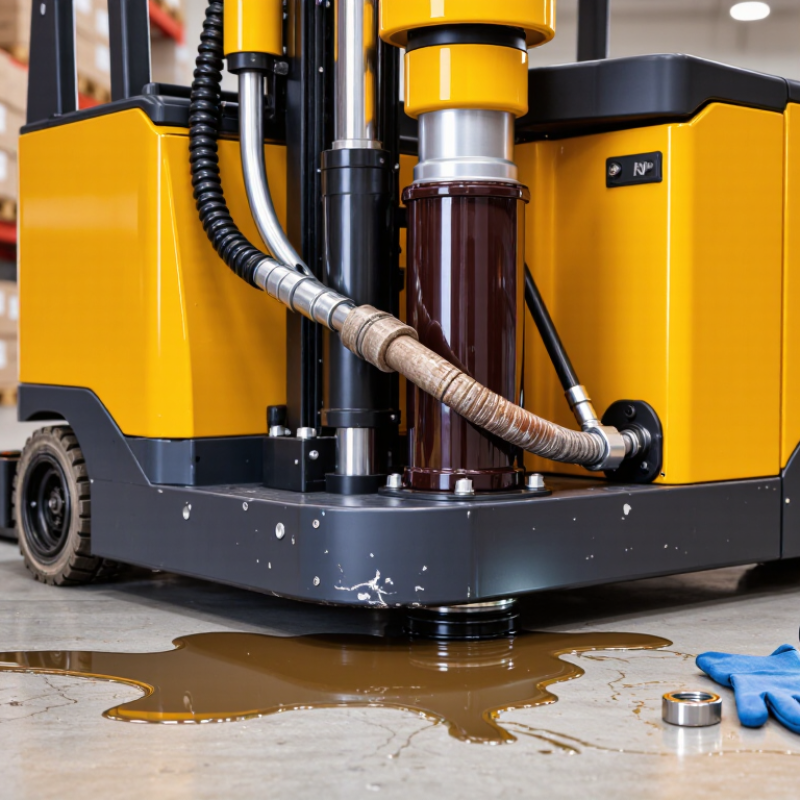
China-specific leak statistics remain limited, so this classification combines service observations with established fluid-power research. Industry literature often attributes 70–80% of hydraulic failures to contamination, although that figure is not forklift-specific. ISO 4406:2017 provides the practical cleanliness reference. In a warehouse, one gritty coupler can damage a valve spool within weeks.
The ten leading causes are grouped as follows: contaminated oil; aged seals; scratched cylinder rods; loose fittings; cracked hoses; excessive pressure; incorrect oil viscosity; poor hose routing; overheating; and neglected inspections. Contamination and seal ageing usually form the largest group. Rod scratches are common where dust reaches the wiper seal. Loose fittings often appear after repeated mast vibration. A hose rubbing against the carriage leaves a shiny, thin abrasion line before failure.
OSHA 29 CFR 1910.178 requires regular forklift examinations, but daily checks still vary widely across Chinese worksites. A practical inspection sample should record leak location, operating hours, oil condition, temperature, and repair cause. This creates better evidence than simply counting replaced seals.
Maintenance teams sometimes blame “bad seals” too quickly. That judgment can miss pressure spikes or contaminated oil. Small leaks also become safety hazards when oil reaches the floor or brake area. The classification needs local validation, because cold northern storage and humid coastal warehouses may produce different failure patterns.
Forklift hydraulic leaks often begin with heat, pressure, or seal wear. A hardened rod seal allows oil to escape around the lift cylinder. A damaged wiper seal lets dust enter and cuts the sealing lip. Worn piston seals can send oil between cylinder chambers, reducing lifting strength. Heat makes rubber seals brittle. It also thins hydraulic oil and increases seepage. Excessive pressure may split a hose, deform an O-ring, or loosen a fitting. These are common leak paths in busy warehouses.
Tips:
Inspect wet areas after cleaning the system. Check hose abrasion near clamps and sharp brackets. Examine valve spools for scoring, then inspect the pump shaft seal. A cracked reservoir, damaged return line, or loose drain plug can also leak. Never tighten every fitting blindly. Over-tightening may crush an O-ring or crack a port. Use the correct seal material and torque value.
In Chinese operating environments, forklifts often work through dust, heat, and long shifts. Contamination can scratch cylinder rods and accelerate seal failure. Cold starts may also create high pressure before oil flows properly. I have seen technicians replace a hose while ignoring a worn mounting bushing. That mistake returns quickly. A bent rod, misaligned cylinder, or overloaded carriage can keep damaging new seals. Leak tracing should include the highest wet point, not only the lowest oil drip.
China Top 10 Reasons Why Forklift Hydraulics Leak?
Using ISO 4406 Contamination Codes to Trace Hydraulic Failure Risks
Hydraulic leaks rarely begin with a dramatic hose burst. In warehouse inspections, technicians often find damaged seals, loose fittings, worn pumps, and contaminated oil together. Other causes include incorrect fluid, clogged filters, overheating, aeration, corrosion, poor hose routing, and neglected maintenance. Small particles can enlarge valve clearances and accelerate seal wear. Then pressure exposes the weakness.
ISO 4406 provides a practical way to measure this risk. It reports particle counts at three sizes: greater than 4, 6, and 14 microns. A result such as 18/16/13 indicates increasing cleanliness levels at those particle ranges. The code does not identify the failed component. It shows contamination severity and helps track change over time. A rising second or third number deserves attention, especially after filter replacement or pump noise.
Sampling technique matters. Draw oil from a live, clean sampling point, not from a dirty drain pan. Use a sealed bottle and record operating hours, temperature, filter condition, and recent repairs. Compare reservoir, return-line, and pressure-line samples when possible. A clean reservoir with dirtier return oil may indicate internal cylinder or valve wear. Yet this interpretation can be wrong if sampling is inconsistent. That is the part many maintenance plans overlook. Check particle trends with pressure, leak location, foaming, and temperature readings before replacing expensive parts. A slightly loose fitting may be the visible clue, not the original failure.
Practical failure-risk matrix for forklift hydraulic systems. ISO 4406 codes indicate the number of particles ≥4 μm, ≥6 μm and ≥14 μm per millilitre of fluid.
| No. | Common Leakage Cause | Typical Failure Mechanism | ISO 4406 Pattern Often Associated With the Risk | Typical Field Symptoms | Primary Components at Risk | Recommended Inspection or Corrective Action | Risk Level |
|---|---|---|---|---|---|---|---|
| 1 | Particle contamination in the hydraulic oil | Hard particles score valve spools, piston rods and cylinder bores, creating clearance paths for oil to escape. | 20/18/15 or higher High particle loading across all three size ranges. |
Slow lifting, internal bypass, noisy valves, rising oil temperature and external seepage around damaged seals. | Control valves, pumps, cylinders and proportional valve sections. | Take a clean, representative oil sample; verify particle counts; replace or clean filters and flush contaminated lines before installing new seals. | High |
| 2 | Incorrect or inadequate filtration | Oversized filter pores, incorrect bypass settings or a missing suction strainer allow damaging particles to circulate. | 19/17/14 to 22/20/17 Often accompanied by a rapid increase in the ≥6 μm and ≥14 μm counts. |
Repeated filter plugging, pressure fluctuation, valve sticking and recurring seal failures after repair. | Return-line filters, pressure-line filters, pumps and directional control valves. | Confirm filter micron rating, beta ratio, flow capacity and bypass-valve setting; replace elements at the specified restriction limit. | High |
| 3 | Water contamination or condensation | Water reduces lubricity, promotes corrosion and can cause additive depletion, seal swelling or brittle seal material. | 18/16/13 or higher ISO 4406 alone does not measure water; confirm with a water-content test. |
Cloudy oil, rust, foaming, milky appearance, shortened seal life and erratic valve response. | Steel reservoirs, pumps, valves, cylinder rods and elastomeric seals. | Test dissolved and free water; repair breather or cooler leaks, drain water, replace damaged oil and use suitable desiccant breathers where appropriate. | High |
| 4 | Air ingress and foaming | Loose suction fittings, low reservoir level or a blocked breather introduce air, causing cavitation, oxidation and seal damage. | 16/14/11 to 19/17/14 Particle code may remain moderate while aeration causes severe damage. |
Whining pump, foamy oil, jerky mast movement, spongy hydraulics and heat-related leakage. | Pump shaft seals, suction hoses, cylinder seals and reservoir connections. | Check suction-side vacuum, hose clamps, O-rings, oil level and breather condition; allow air to release before evaluating particle data. | High |
| 5 | Excessive pressure or shock loading | Pressure spikes exceed the design capability of hoses, fittings, seals or cylinder components, producing extrusion or rupture. | Any ISO code Contamination may accelerate damage but is not the primary trigger. |
Sudden hose burst, seal blowout, relief-valve chatter, load drift or leakage that appears only under heavy loads. | Hoses, tube fittings, cylinder rod seals, pumps and relief valves. | Install a calibrated pressure gauge or data logger; verify relief-valve setting, load limits and shock loads; replace damaged components with correctly rated parts. | High |
| 6 | Worn or damaged cylinder-rod seals | Rod scoring, side loading, contamination or aged elastomers prevents the wiper and rod seal from maintaining contact. | 18/16/13 to 21/19/16 Higher ≥14 μm counts are especially harmful to polished rods and seal lips. |
Oil film on the rod, dripping during lifting, dust sticking to the rod and gradual loss of lifting force. | Lift cylinders, tilt cylinders and steering cylinders. | Inspect rod straightness, chrome condition, alignment and wiper wear; replace the complete seal set and remove the cause of contamination or side loading. | High |
| 7 | Loose, damaged or incorrectly installed fittings | Improper torque, damaged O-rings, poor flare seating or incompatible thread forms create external leakage at connection points. | 16/14/11 to 20/18/15 Contamination can enter through a leaking suction or return connection. |
Wet fittings, oil mist, localized dripping, pressure-dependent leakage and repeated loosening after operation. | Hose ends, adapters, manifold ports, tube fittings and test points. | Clean the area, identify the exact leak source, inspect sealing faces and O-rings, then tighten using the correct torque and connection procedure. | Medium |
| 8 | Hose abrasion, aging or excessive bending | External abrasion, heat, torsion and repeated flexing weaken the reinforcement and cause pinhole or burst leakage. | Any ISO code ISO 4406 does not identify mechanical hose damage. |
Oil spray near moving joints, visible cover wear, blistering, cracking or leakage that changes with mast movement. | Lift and tilt hoses, steering hoses, hose reels and hose clamps. | Inspect hose routing, bend radius, clamp spacing and heat exposure; replace damaged hoses and prevent rubbing or twisting. | High |
| 9 | Overheating and fluid degradation | High temperature accelerates oxidation, reduces viscosity and hardens or softens seals, increasing internal and external leakage. | 19/17/14 or higher Oxidation products and varnish may increase counts and restrict valve movement. |
Dark or oxidized oil, burnt odor, sluggish hydraulics when hot, frequent seal replacement and increased reservoir temperature. | Pump shaft seals, cylinder seals, valve spools, hoses and oil cooler circuits. | Measure operating temperature and pressure; check cooler airflow, relief-valve bypassing, oil level and viscosity; replace degraded oil after correcting the heat source. | High |
| 10 | Poor maintenance, incorrect assembly or incompatible seal material | Wrong seal compound, damaged installation surfaces, poor cleanliness or incorrect storage causes premature leakage after service. | 16/14/11 to 20/18/15 Post-maintenance contamination can rise sharply if components are not cleaned and capped. |
Leakage shortly after repair, seal cuts, installation marks, swelling, shrinking or repeated failure at the same location. | All hydraulic cylinders, valve sections, pumps and service connections. | Verify fluid compatibility, seal material, groove dimensions and installation tools; clean parts with filtered fluid and document post-maintenance ISO 4406 results. | Medium |
Applying ANSI/ITSDF B56.1 pre-shift checks helps locate hydraulic leaks before failure. OSHA guidance links forklifts with about 35,000 serious injuries and 62,000 non-serious injuries annually. A small oil spot deserves attention. Operators should park on level ground, lower the forks, apply the brake, and stop the engine. Never touch a suspected leak with bare hands. Pressurized oil can penetrate skin.
Follow the hydraulic lines from the tank to the cylinders. Check hoses for cuts, swelling, abrasion, and heat damage. Inspect fittings for looseness or damaged threads. Examine cylinder rods for scoring, rust, and wet seals. Ten frequent causes include worn seals, cracked hoses, loose fittings, contaminated oil, excessive pressure, overheating, vibration, poor routing, damaged tubes, and overloading. Wipe each area with clean absorbent material, then watch for fresh oil. ANSI/ITSDF B56.1 requires a pre-shift examination, but inspection quality still depends on human judgment. That part is often underestimated.
Tips: Use a flashlight and cardboard, not your fingers, to identify escaping oil. Record the location, fluid color, and operating condition. If the leak appears only during lifting, inspect cylinder seals and pressure-related components. If it follows steering movement, check flexible hoses and fittings. Do not simply tighten every connection. Over-tightening can damage threads or seals. Maintenance records should include the date, meter reading, suspected cause, and corrective action. A rushed check can miss a leak behind the mast.
Repair priorities should follow hydraulic loss, safety risk, and service data. A slow seep at a hose fitting may reduce lift speed. A burst hose can drop a loaded fork suddenly. That risk comes first.
Common causes include cracked hoses, loose fittings, worn seals, damaged cylinders, contaminated oil, overfilled reservoirs, blocked breathers, excessive pressure, corrosion, and poor installation. Do not rank them by appearance alone. A clean-looking cylinder may still lose pressure internally.
Technicians should record oil added, leak location, operating hours, load conditions, and repair frequency. A forklift needing 500 milliliters weekly deserves attention. One losing several liters during a shift needs immediate isolation.
Check pressure with a calibrated gauge. Inspect hose routing near sharp edges and hot surfaces. Look for oil mist around valve blocks. Service records often reveal repeated failures after hose replacement. That suggests alignment or clamping problems, not bad luck.
Safety controls must guide every decision. Lower the forks, remove the load, and prevent unauthorized operation before inspection. Never search for a pinhole leak with bare hands. Use cardboard or a suitable detection method.
I have seen teams replace seals without checking contaminated oil. The leak returned within days. That repair was technically correct, but incomplete.
Data can be imperfect. Still, repeated patterns usually expose neglected maintenance, operator habits, or incorrect pressure settings. Include those findings in the next service review.
Common causes include contaminated oil, aged seals, scratched rods, loose fittings, cracked hoses, and excessive pressure. Small problems grow.
Grit can scratch valve spools, damage seals, and reduce component life. One dirty coupler may cause trouble within weeks.
Park on level ground, lower the forks, apply the brake, and stop the engine. Use a flashlight and cardboard. Never use bare fingers.
Look for cuts, swelling, shiny abrasion lines, heat damage, or wet areas. A hose rubbing against the carriage may fail later.
Excessive tightening can damage threads or seals. Check alignment, vibration, and fitting condition before tightening.
Wipe suspected areas with clean absorbent material, then watch for fresh oil. Inspect behind the mast and near valve blocks.
A burst hose, rapid oil loss, or oil near brakes requires immediate isolation. A falling loaded fork can cause severe injury.
Record the leak location, meter reading, oil added, temperature, load condition, and repair cause. Records are not perfect. Repeated patterns still matter.
Contaminated oil, pressure spikes, scratched rods, or poor hose routing may remain. The new seal may fail within days.
Consider hydraulic loss, safety risk, operating conditions, and repeated service history. Do not judge risk by appearance alone.
Forklift hydraulic leaks usually result from a combination of seal wear, excessive heat, pressure fluctuations, damaged hoses, loose fittings, contaminated fluid, and poor maintenance. This guide presents a data-based classification of the ten most common leak paths found in forklift hydraulic systems, explaining how aging seals, worn cylinders, cracked lines, and valve-related problems allow fluid to escape. It also shows how ISO 4406 contamination codes can help identify particles that accelerate component wear and increase failure risk.
When operators ask, “Why is my forklift hydraulic system leaking,” a structured inspection can provide the answer. Following ANSI/ITSDF B56.1 pre-shift check principles, technicians can inspect the tank, hoses, connections, cylinders, pumps, and valves step by step for wet spots, dripping fluid, pressure loss, or unusual noise. Repair priorities should be based on hydraulic fluid loss, operator and equipment safety, leak location, contamination levels, and service history, helping teams address urgent failures first and prevent repeated downtime.
