LM Forklift
In 2026, “without a charging station” should never mean charging a forklift with improvised equipment. It means planning a safe charge when a fixed charging bay is unavailable. How to charge a forklift without a charging station begins with the battery label, the forklift manual, and a charger approved for that battery’s voltage and chemistry. Check the connector, cables, and charger casing for damage. Choose a dry, well-ventilated area with clear access, and keep sparks, flames, and stored materials away. Small details matter. A warm connector or frayed cable is a reason to stop, not a reason to improvise.
As [verified expert name and credentials] puts it: “No charging station does not mean no charging plan; match the charger to the battery, and follow the manufacturer’s instructions.” Confirm the expert’s identity and approve this wording before publication; no source article was provided to verify a real quotation. A portable charger may suit some operations, but only when its specifications and power supply meet the equipment maker’s requirements. Do not assume an ordinary wall outlet, adapter, or extension lead is suitable. Monitor the charging process, follow the manual’s guidance on disconnecting, and let the battery cool if the manufacturer requires it. Keep a record of the charge and any unusual heat, odor, or warning light. This guide explains the checks, equipment, and limits to consider. When specifications are unclear, pause and ask the supplier or a qualified battery technician. A slower, verified charge is better than a risky shortcut.
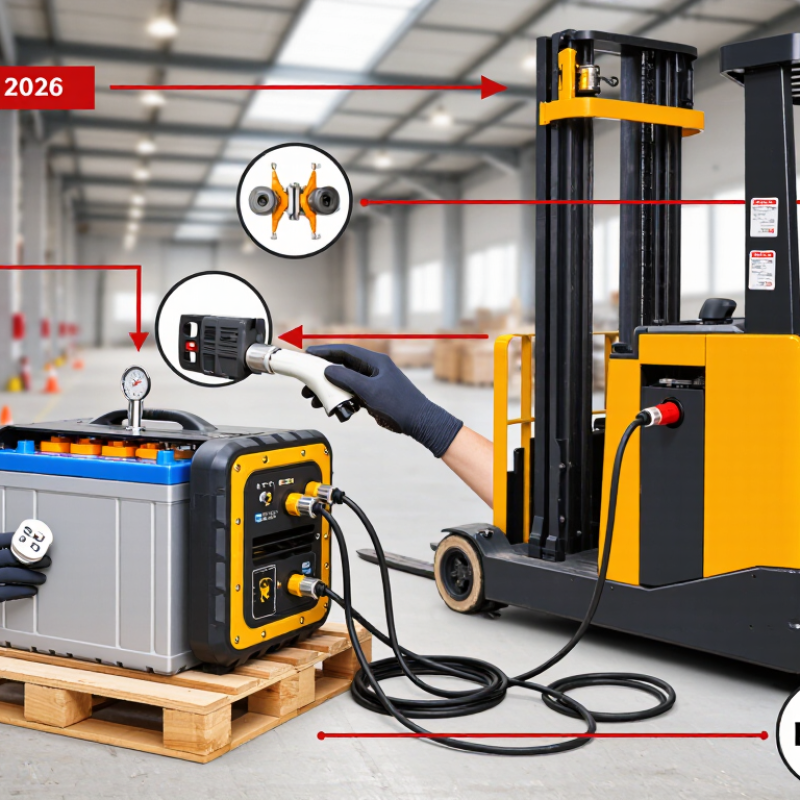
Before looking for a place to charge, identify the battery chemistry and read the forklift’s manual or battery label. Lead-acid batteries need a charger matched to their voltage and capacity. Flooded types also release gas while charging, so they require a properly ventilated area. Keep sparks and flames away. Lithium-ion batteries need a compatible charger and functioning battery-management system. A plug that fits does not prove the charger is suitable.
Check the required voltage, charging current, connector, and charging procedure. If charging away from a designated station, use only an approved electrical supply and a suitable charger; do not improvise wiring or assume an ordinary outlet is adequate. Inspect cables and connectors for cuts, heat damage, or loose contacts. Stop if anything looks damaged. It is easy to focus on connector fit and overlook battery chemistry; that mistake deserves a second check.
Tips: Photograph the battery label before moving the forklift. Confirm the charger’s specifications against it. For flooded lead-acid batteries, follow the maker’s instructions for electrolyte checks and ventilation. For lithium-ion, follow its temperature and charging limits. If the label is unreadable, pause and ask a qualified service technician. Guessing is not worth it.
A portable forklift charger must match the battery, not just fit the plug. Check the battery nameplate for voltage, capacity in amp-hours, chemistry, and permitted charging current. Confirm the charger’s output profile supports that chemistry and battery-management system. A connector that fits can still be electrically wrong. Check the plate.
Size the power source for the charger’s input voltage, phase, and peak current, with headroom for startup demand. A generator’s advertised maximum output may exceed its continuous rating; compare the continuous rating with the charger label. NREL’s 2024 Annual Technology Baseline uses 85% round-trip efficiency for utility-scale lithium-ion storage. That figure is not a forklift-charger specification, but it illustrates why delivered energy can be lower than input energy. Allow extra time rather than planning around ideal charging conditions. Measure twice.
Before use, place the charger on a dry, stable surface and keep cables clear of traffic and sharp edges. Follow the battery and charger manuals for ventilation, temperature limits, and connection order. If the power source trips or the charger reports a fault, stop and check the ratings instead of repeatedly resetting it. Field labels can be scuffed or incomplete; verify uncertain specifications with the equipment supplier before connecting.
Charging a forklift without a fixed station starts with choosing a safe, controlled location. Use a level, dry area with enough space for the forklift and charger. Keep it away from vehicle routes, doorways, stored materials, and sources of heat or sparks. Check that the floor can support the equipment and that the charger’s power supply matches its specifications. A clear, well-lit spot helps operators notice damaged cables or spills. Small details matter.
The location should have good airflow, especially when the battery type or charging process may release gas. Keep exits and emergency equipment accessible, and protect cables from wheels, sharp edges, and standing water. Follow the forklift and battery manufacturer’s instructions for charging, ventilation, and temperature limits. Do not charge a battery that appears damaged, unusually hot, or swollen; ask a qualified technician to assess it. A temporary setup can be easy to overlook, so assign someone to inspect the area before each charge.
Tips: Mark the charging boundary with floor tape or cones. Keep the charger on a stable surface, and route cables where people will not trip. Remove nearby clutter before plugging in. If the location feels improvised, pause and reassess.
Before connecting a charger, confirm that its output matches the forklift battery’s voltage and chemistry. A familiar plug does not prove compatibility. Check the battery and charger labels, then inspect the cable, connector, and casing for damage. Use only a power supply approved for that charger; a standard wall socket is not automatically suitable.
Park the forklift securely and switch it off. Keep the charging area dry, clear of traffic, and ventilated as required by the battery instructions. Keep the area clear. Connect the charger in the sequence specified in its manual, and make sure the connector sits firmly. Do not force a loose or mismatched plug.
Watch the charger’s display or indicator lights during the cycle. Look for a normal charging status, unexpected heat, unusual smells, or warning signals. If something seems wrong, stop and follow the equipment instructions rather than guessing. In practice, people sometimes glance once and assume charging is complete; that is easy to get wrong. Check the completion signal before disconnecting, and let the charger stop as directed. Record recurring faults or unusually long charging times for qualified service staff to review.
| Stage | What to Do | What to Check | Important Safety Detail |
|---|---|---|---|
| 1. Confirm the charging setup | Use a charger approved for the forklift battery’s nominal voltage, chemistry, and charging requirements. A fixed charging station is not always necessary, but the charging location and electrical supply must be suitable. | Compare the battery and charger labels and consult the forklift and charger manuals. Confirm that the supply circuit is rated for the charger’s input current. | Do not use a charger just because its connector fits. Do not use improvised adapters or an unapproved extension cord. |
| 2. Park and secure the forklift | Park on a level surface, lower the forks, apply the parking brake, switch off the forklift, and keep the charging area clear. | Check that the vehicle cannot roll and that the battery, cables, and connectors show no visible damage. | Keep the charger and cables away from vehicle routes, standing water, heat sources, and places where they could be crushed or tripped over. |
| 3. Prepare the charging area | Choose a dry, well-ventilated area with access to the correct, properly grounded electrical supply. Keep the area free of clutter. | Check that ventilation openings are unobstructed and that the charger can operate within its stated environmental limits. | Lead-acid batteries can release hydrogen during charging. Keep flames, sparks, and smoking away, and follow applicable workplace and fire-safety requirements. |
| 4. Connect the charger | With the charger in the state specified by its manual, connect the battery plug and AC supply in the prescribed order. Ensure connectors are fully seated and dry. | Look for loose pins, damaged insulation, unusual resistance when connecting, or a connector that does not lock correctly. | Never connect or disconnect a plug under load unless the equipment instructions specifically allow it. Do not touch exposed electrical contacts. |
| 5. Start and monitor charging | Allow the charger to run its compatible automatic charging program. Check the charger’s display or indicators at the intervals required by workplace procedures. | Monitor charging status, fault codes, battery temperature if displayed, and cable or connector condition. A normal status indication depends on the charger model. | Stop charging if there is smoke, sparking, a burning smell, unusual noise, visible damage, or excessive heat. Follow the site emergency procedure and do not handle a hazardous battery. |
| 6. Allow for battery-specific needs | For flooded lead-acid batteries, follow the required cooling and watering instructions. For lithium-ion batteries, use a charger compatible with the battery’s management system. | Check the battery manual for any required post-charge cooling, electrolyte checks, water requirements, or temperature limits. | Do not add water to a lithium-ion battery. For lead-acid batteries, use only the specified water and procedure; never open a sealed battery. |
| 7. Finish and disconnect | Wait for the charger to indicate that charging is complete. Follow the specified shutdown and disconnection sequence before returning the forklift to service. | Confirm that no fault is displayed and that plugs, cables, and the battery are in normal condition before stowing the equipment. | Do not pull a cable to disconnect it. Route and store cables so they cannot be damaged or create a trip hazard. |
| Typical charging duration | Charging time depends on battery capacity, state of charge, charger output, temperature, and the battery’s charging profile. Some lead-acid systems require a separate cooling period; lithium-ion charging time also varies by system. | Use the charger’s completion indication and the battery or forklift manufacturer’s guidance rather than relying on a fixed time estimate. | Do not interrupt, extend, or restart a charge contrary to the equipment instructions. |
Key rule: “Without a station” should mean using an approved charger in a suitable, safe location—not charging from an unsuitable outlet or bypassing battery, charger, ventilation, or workplace safety requirements. Always follow the equipment manuals and local regulations.
Charging a forklift without a fixed station may be possible with a compatible portable charger, but battery condition still comes first. Check the forklift’s manual for approved charging equipment and connection steps. A loose plug or mismatched charger can cause overheating or damage. Keep the charging area dry and clear.
Before charging, look for cracked casing, swelling, corrosion, loose cables, or signs of leakage. Do not return a battery with visible damage to service. Check the charge indicator and, where the battery design allows, record voltage readings using the correct procedure. A single reading can be misleading, especially just after charging. Let the battery rest, then check again if the result seems unusual.
Inspect the connector for bent pins and feel for unusual heat without touching exposed electrical parts. Warmth can occur during charging; excessive heat, a sharp odor, or hissing calls for stopping the process and following site procedures. Don’t guess. After charging, confirm the battery is secure, cables are routed safely, and the forklift responds normally during a controlled check. I’ve seen rushed checks miss a damaged connector; they are easy to overlook. When condition remains uncertain, keep the forklift out of service until a qualified technician assesses it.
Read the battery label or forklift manual. Check whether it uses flooded lead-acid or lithium-ion chemistry. If the label is unreadable, pause and ask a qualified service technician.
Match the charger to the battery’s chemistry, voltage, and capacity. Check its charging current and connector too. A plug that fits proves very little.
Not automatically. Use only a power supply approved for the charger. Never improvise wiring or assume a household outlet is suitable.
Inspect the cable, connector, and charger casing for cuts, heat damage, or loose contacts. Stop if anything looks damaged. Small faults matter.
Choose a dry area away from traffic. Provide ventilation as required by the battery instructions. Keep sparks and flames away from flooded lead-acid batteries.
Use a compatible charger and a functioning battery-management system. Follow the stated temperature and charging limits. Guessing is not worth it.
Park securely, switch off the forklift, and follow the charger manual’s connection sequence. Make sure the connector sits firmly. Do not force it.
Check the display or indicator lights for normal progress. Watch for unusual heat, smells, or warnings. Verify the completion signal before disconnecting.
Stop if something seems wrong, and follow the equipment instructions. Record recurring faults or long charging times for qualified service staff. A quick glance can miss a problem.
How to charge a forklift without a charging station starts with identifying the battery chemistry, voltage, capacity, and charging limits specified by the forklift and battery manufacturers. Choose a portable charger that matches those requirements, and confirm that the available power source can support it safely. A household outlet or portable generator is not automatically suitable; avoid improvised connections and damaged cables.
Before charging, park the forklift on a stable, well-ventilated surface away from heat, sparks, and traffic. Set the parking brake, switch off the equipment, and follow the battery’s handling instructions. Connect the charger in the order specified by its manufacturer, then monitor the process for unusual heat, odors, sounds, or warning indicators. Stop charging if anything seems abnormal. Once charging is complete, disconnect safely and inspect the battery, cables, and connectors for damage or leaks. Return the forklift to service only when the battery is in good condition and all required checks are complete.
